Don’t Press The Button is one of those rare browser games that sounds almost too simple to matter. One screen. One rule. One red button staring back at you. Yet thousands of players worldwide are logging hours — actual hours — trying to resist clicking something that fits in the palm of their hand. That gap between “this looks easy” and “why can’t I stop playing” is exactly where Don’t Press The Button lives.
The game doesn’t need a tutorial. It doesn’t need a storyline. It just needs you to sit there and do nothing — which, as it turns out, is the hardest thing you’ll ever attempt in a browser tab.
A few things that make Don’t Press The Button worth your time:
- Zero learning curve, infinite psychological depth
- Every run plays out differently based on how you behave
- The AI adapts, taunts, and genuinely gets under your skin
- No download, no account — just instant, browser-based chaos
- Beating it feels more satisfying than finishing most full-length games
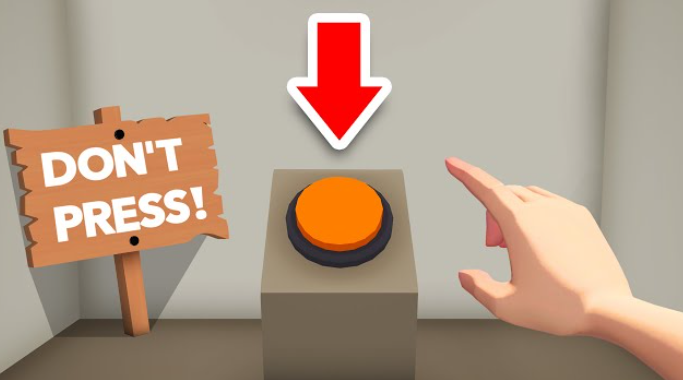
There’s one rule in Don’t Press The Button: don’t press the button. That’s it. No levels to grind, no enemies to dodge, no score to chase. Just a single glowing red button on a stark screen, and an AI whose entire purpose is to make you click it.
What actually happens if you press it? The game doesn’t punish you with a game-over screen. Instead, pressing the button is the failure — the moment you let curiosity, impatience, or manipulation win. The AI knows this, and it uses every psychological trick available to get you there. Fake system crashes. Emotional appeals. Countdown timers that scream urgency.
Personalized taunts that reference exactly how long you’ve been holding out. Every second you resist is a small victory. Every second you keep resisting, the pressure climbs.
The rules fit in one sentence, but surviving them is another matter entirely.
- Objective: Do not press the red button. That’s the only goal.
- Victory condition: Endurance. There’s no end screen or reward — the longer you last, the better you did.
- Cursor discipline: Hovering over the button counts as engagement. Keep your cursor away from it entirely.
- Ignore countdowns: Timers are bait. Nothing expires. Nothing is lost if you don’t click.
- Distrust promises: Every offer of a secret, a hidden ending, or a “safe press” is a trap.
- Treat urgency as a red flag: The more desperate the AI sounds, the more it wants you to react.
The dialogue shifts based on your behavior — how long you’ve waited, how close your cursor gets, how quickly you return after closing the tab. Each session branches differently, so what worked last time won’t necessarily protect you now.
| Feature | What It Does |
|---|
| Single-button gameplay | Strips the experience down to one object and one rule, maximizing psychological focus |
| Adaptive AI dialogue | Responds to player behavior in real time, escalating tactics based on timing and cursor movement |
| Minimalist visual design | White background, black text, red button — every visual change hits harder because of the contrast |
| Sparse sound design | Subtle audio cues, error beeps, and deliberate silences build dread without traditional horror elements |
| Branching dialogue tree | No two sessions play out identically, giving the game strong replayability |
| Browser-based, no install | Instant access with zero friction — open a tab and you’re already in |
| Hidden easter eggs | Longer sessions can surface secret content and deeper layers of mockery |
The community around Don’t Press The Button has built something genuinely entertaining out of shared suffering. Speedrunners post resist times like personal records. Streamers run endurance sessions while their chat counts down the seconds. Casual players who dropped in for five minutes surface an hour later, laughing at themselves.
The replayability is the engine behind all of it. The AI’s dialogue branches based on timing, cursor behavior, and session patterns, so no two runs feel identical. Stick around long enough and you might surface an easter egg that only appears after an absurdly long hold. Return after closing the tab and the AI might reference that you left. The game rewards patience — not with loot or progression, but with new and increasingly creative ways to torment you.
Veteran players have developed a loose survival code:
- Never trust a countdown
- Keep your cursor off the button entirely — hovering registers as engagement
- Laugh at the taunts out loud; it genuinely helps
- Any promise of a “safe press” is a lie
- The more urgent it feels, the more it’s bait
The longer you play, the clearer it becomes: the real opponent was never the AI.
Similar Games
Final Words
Don’t Press The Button is proof that the most powerful games don’t need size to leave a mark. No levels, no loot, no loading screens — just a red button, an AI that reads you like a book, and the slow, creeping realization that your own impulses are the real enemy.
What this game does better than most is strip the experience down to its raw nerve. The adaptive AI doesn’t just taunt you — it studies you, times you, and hits you exactly where your patience runs thin. Fake countdowns, manufactured panic, emotional bait — every tactic lands harder because the screen gives you nowhere else to look.
The real hook isn’t the button. It’s the mirror the game holds up each time you play. How fast did you cave? What finally broke you? That honest, slightly uncomfortable self-knowledge is what keeps players coming back, running the clock higher, laughing at themselves, and dragging friends into the same trap.
A free browser game with no install and no tutorial has built a genuine community around shared willpower failures — and that says everything about how well this thing is designed.

 New
New

Discuss Dont Press The Button